
 Launching a connected device that seamlessly operates in diverse environments under all potential conditions users may put it through requires exhaustive testing across various network configurations and wireless protocols such as Zigbee, Matter, Thread and Bluetooth Mesh. As an IoT testing services provider, our goal is to build a robust device that works in every conceivable real-world situation.
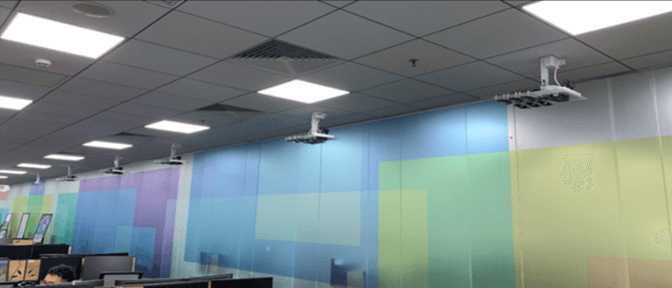
Our 150+ node test bed, one of the largest in the world, was originally built to support our Silicon Labs Offshore Development Center to test Zigbee networks with a high node count. Now expanded to include Matter, Thread, and Bluetooth Mesh, this specialized facility provides customers with extensive automated IoT device connectivity testing at a scale that few others can match. This capability, combined with our extensive IoT engineering expertise, ensures the most efficient connected product development.
150+ Node IoT Test Bed for At-Scale Connectivity Testing
Our Zigbee network testing services speed product development by identifying exact, real-world failure scenarios and ensuring both end-user devices and gateways are robust. The complete system automatically tests Zigbee wireless devices, as well as Matter, Thread and Bluetooth Mesh devices, at scale throughout the product development process.
Set up is quick and the IoT testing solution supports multiple wireless protocols. It is both lightweight and flexible to adapt to each specific project’s requirements.
Large Zigbee, Matter, Thread and Bluetooth IoT Testing Facility
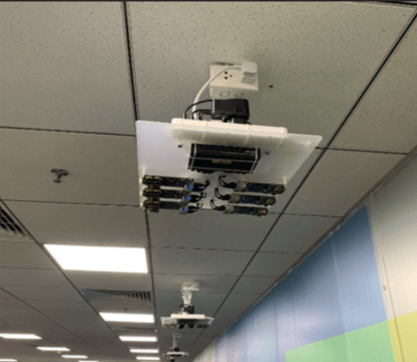
Close-Up of an IoT Network Testing End Node
Automated Zigbee and IoT Device Testing Services at Scale
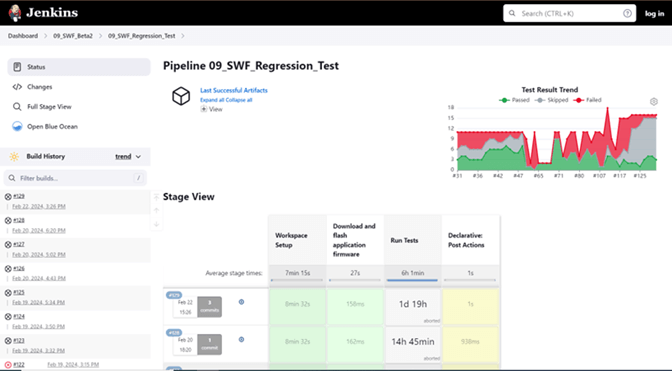
The IoT testing solution is automated with Jenkins. As new software is developed, it is automatically deployed on the end nodes and gateway devices, where a series of tests run, and the results are automatically recorded as part of a complete continuous integration and continuous delivery (CI/CD) system — lowering the time and cost required for regression testing.
Zigbee, Thread, Matter and Bluetooth Mesh Network Testing System Framework
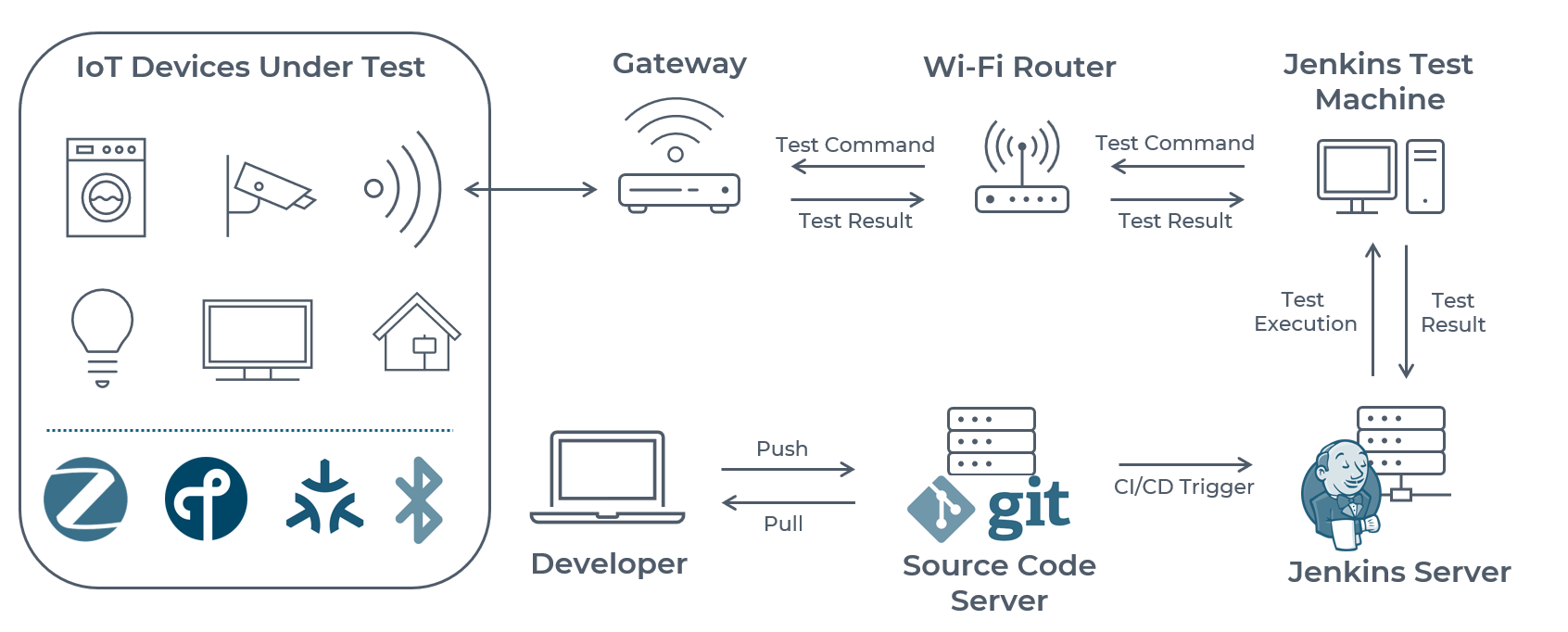
The large Zigbee network testing services, along with Matter, Thread and Bluetooth Mesh testing, allow us to run tests more frequently throughout the development process, ensuring that the final product will be robust and work under the broadest range of conditions. Using Python scripts, we simulate real-world events (e.g., button presses) to test every function of every module separately (component testing), between modules (integration testing) and the whole system (system testing/acceptance testing).
Comprehensive Internet of Things Testing Services
Component Testing
Component testing checks the function of individual components separately. Also known as module or unit testing, it ensures that each component works as expected and meets requirements.
Integration Testing
Integration testing ensures different units, modules or components work together as designed. Common approaches include top-down, bottom-up and incremental testing.
System Testing/Acceptance Testing
Also known as end-to-end testing, system testing helps validate specified requirements to ensure systemwide functionality. User acceptance testing (UAT) involves testing from a user’s perspective.
This level of automation allows us to run hundreds of test cases per day. By validating embedded software on gateways and end devices, the system identifies defects and allows software developers to quickly address any issues. Comprehensive test coverage in this large network helps our clients confidently know that their products are robust and will delight users.
Jenkins Test Automation
If you need help developing or testing Zigbee, Matter, Thread and Bluetooth Mesh end devices or gateways, please reach out to explore how we can help.
The Benefits of Our Automated Zigbee, Matter, Thread and Bluetooth Testing Services
 | Faster development cycles | Run daily regression tests to catch and resolve bugs early. |
 | Enhanced product quality | Validate firmware for gateways and devices with confidence. |
 | Cost efficiency | Greatly reduce manual testing efforts, saving time and resources. |
 | Scalable solutions | Seamlessly integrate with projects of any size or complexity. |
Integrated IoT Product Design Services




IoT Testing Services Related Articles
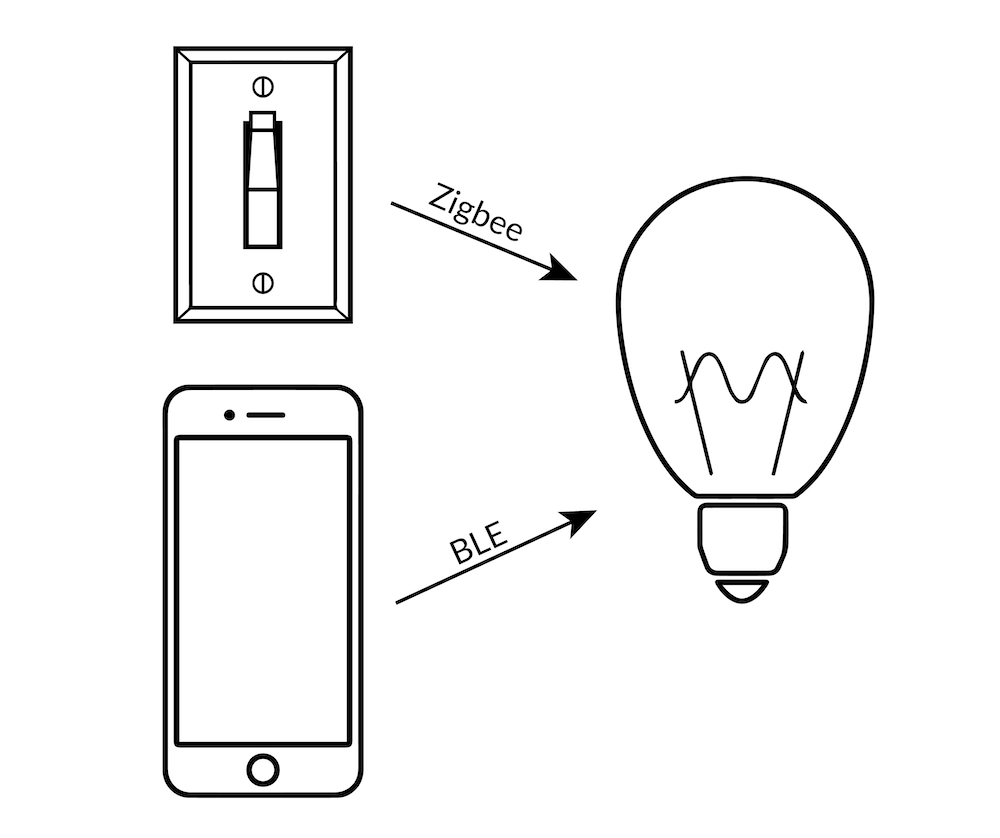
IoT Lighting with Multiprotocol Connectivity
Follow our engineer in developing a low-cost, low-power connected lighting solution that simultaneously supports BLE and Zigbee on the same chip and radio using Silicon Labs’ dynamic multiprotocol offering.
Bluetooth LE Security and Privacy in Wireless Audio Devices
Despite its many advantages, Bluetooth LE can present security challenges. Our engineer details the security concerns and how to secure BLE devices using randomized addresses.

Matter Smart Home Standard Allows Smart Home Devices to Work Together
Competing smart home standards complicate how we interact with our appliances, thermostats, home assistants and other connected devices at home, but Matter aims to align device interoperability across brands and platforms.
Follow our engineer in developing a low-cost, low-power connected lighting solution that simultaneously supports BLE and Zigbee on the same chip and radio using Silicon Labs’ dynamic multiprotocol offering.
Despite its many advantages, Bluetooth LE can present security challenges. Our engineer details the security concerns and how to secure BLE devices using randomized addresses.
Competing smart home standards complicate how we interact with our appliances, thermostats, home assistants and other connected devices at home, but Matter aims to align device interoperability across brands and platforms.
IoT Testing Solutions FAQs
Why is large-scale mesh network testing necessary?
Large-scale mesh testing is necessary because wireless protocols like Zigbee, Thread, and Matter exhibit non-linear behavior as node count increases. Bench testing with a few devices cannot simulate the packet collisions, latency spikes, and routing table saturation that occur in real-world high-density deployments (such as smart lighting or industrial sensor networks).
How does automated testing differ from manual bench testing for IoT?
Automated IoT testing uses software scripts to control physical hardware, executing thousands of repetitive test cycles without human intervention. Unlike manual bench testing, automation allows for continuous regression testing (running the full test suite every night), ensuring that new code commits do not introduce bugs into the embedded software or degrade RF performance.
What are the key performance metrics for Matter and Zigbee networks?
Critical metrics for mesh health include Packet Error Rate (PER), latency (round-trip time), throughput, and Received Signal Strength Indicator (RSSI) stability. Measuring these metrics across hundreds of nodes simultaneously helps identify “choke points” in the mesh topology and verifies that the network can successfully self-heal when a router node goes offline.
How is CI/CD applied to embedded hardware testing?
CI/CD (Continuous Integration/Continuous Deployment) for IoT involves using tools like Jenkins to trigger physical device actions—such as firmware flashing, rebooting, and state changes—whenever new code is committed. This integrates the hardware test bed directly into the software development lifecycle, allowing engineers to identify and fix interoperability issues immediately rather than at the end of the release cycle.